
The industry's first "Green Intelligent Compressed Air Station Evaluation" released | Led by Fengdian Technology as chief editor
The industry's first "Green Intelligent Compressed Air Station Evaluation" released | Led by Fengdian Technology as chief editor, promoting healthy and orderly industry development through standards
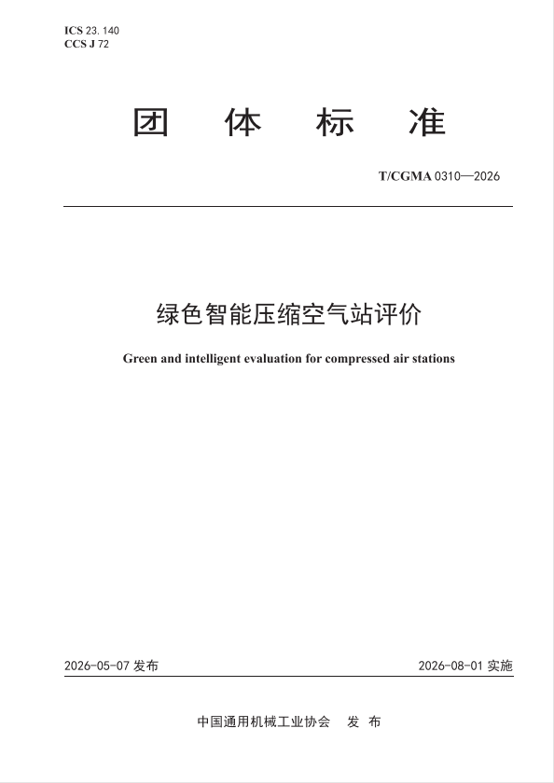
Recently, the industry's first quantitative evaluation standard for green and intelligent compressed air stations, T/CGMA 0310—2026 "Green Intelligent Compressed Air Station Evaluation," was officially released. It was proposed by the China General Machinery Industry Association and administered by the Compressor Branch. Fengdian Technology Group Co., Ltd. served as the chief editing unit, working with multiple parties across the industrial chain—including system energy-saving, mainframe manufacturing, core components, and testing institutions—to jointly draft the standard. Closely aligning with the national macro guidance of implementing the "dual carbon + AI" strategy, advancing industrial energy conservation and carbon reduction, and developing new quality productive forces, the standard for the first time incorporates "green performance" and "intelligent capability" into the same quantifiable and verifiable indicator system, filling the domestic standard gap in this field.
One ruler measures two types of capabilities
Compressed air is a fundamental power source for manufacturing and broadly supports key industries such as semiconductors, steel, chemicals, and high-end equipment. Its energy efficiency level, operational safety, and digital capabilities directly affect the effectiveness of energy conservation and carbon reduction in the industrial sector and the stability of industrial and supply chains. For a long time, the industry has lacked a unified yardstick, with green evaluation and intelligent assessment separated from each other, making it difficult to carry out systematic, closed-loop benchmarking diagnostics for compressed air stations. The newly issued standard innovatively constructs a "one system, two types of capabilities" evaluation framework: on the one hand, it anchors green bottom lines such as energy performance, environmental health, safety control, and operation and maintenance management; on the other hand, it covers intelligent dimensions such as intelligent perception, fault diagnosis, interconnected collaboration, and adaptive optimization, achieving integrated measurement of energy-saving level and autonomous regulation capability, and providing a unified basis for enterprise quality improvement and renovation, industry supervision, and energy efficiency certification.
The standard applies to compressed air stations that are motor-driven, have an exhaust pressure of 0.25 MPa to 1.6 MPa, an air supply volume of ≥ 4 m?/min, and a total operating power of units ≥ 37 kW; it does not apply to air separation stations or special locations such as underground or in tunnels. The evaluation object is required to be an in-service station that has been in stable operation for more than 6 months. The evaluation boundary runs through the entire process of intake filtration, compression and purification, air storage, pipeline network, electrical control, monitoring, and waste heat recovery, using the complete system and actual operating conditions as the evaluation carrier to ensure that evaluation results are authentic and verifiable and that outcomes can be replicated and promoted.
From Methodology to Industry Standards
Fengdian Technology has incorporated a mature methodology validated through projects into the standard text. Relying on the ternary value theory system of "30 years of experience × optimization of hardware and process mechanisms × AI," Fengdian Technology has built a three-generation AI large-model and agent system—"Qinglong No. 1 · Can Calculate — Qinglong No. 3 · Can Decide — Qinglong No. 5 · Dares to Self-Determine"—pioneering a path of system-level autonomous optimization under mechanism constraints and establishing the core principles of physical AI: safety first, stability as the foundation, and only then energy saving, making process mechanisms the safety base of AI algorithms and avoiding the risk of purely data-driven algorithms becoming detached from industrial sites and one-sidedly pursuing energy savings.
Supporting this methodology are large-scale engineering samples. At present, Fengdian Technology has served more than 3,000 Fortune Global 500 and industry-leading enterprises, including BOE, China Electronics, BASF, ESWIN, Wingtech Technology, SMIC, ChangXin Memory Technologies, Renesas Semiconductor, Midea Group, and Panasonic. It has implemented more than 5,200 compressed air system and energy-saving renovation projects and holds 170 patents and software copyrights. Fengdian Technology is the first national-level specialized, refined, distinctive, and innovative "little giant" enterprise in the field of compressed air energy saving, and the only compressed air system energy-saving technology enterprise recommended by the National Energy Conservation Center and evaluated as "domestically leading." Its related systems have been included in the Ministry of Industry and Information Technology's "Recommended Catalog of Energy-Saving and Carbon-Reduction Technologies and Equipment in the National Industrial and Information Technology Field."
The true maturity of physical AI requires upgrading from methodology to industry standards, transforming 30 years of accumulated experience, mechanism research, and AI technology accumulation into a measurable yardstick that is verifiable and reusable across the entire industry.
Making standards take root
Leading the compilation of the standard is essentially about transforming the implicit engineering experience accumulated by the enterprise over the long term into explicit rules that are shared across the industry and can be implemented. This is not only Fengdian Technology's technical responsibility but also its mission to serve high-quality industrial development.
In the future, Fengdian Technology will continue to be guided by standards, take high-end equipment as the foundation, and use physical AI as the core empowerment, working with upstream and downstream partners in the industrial chain to jointly promote standard implementation, evaluation, and demonstration promotion, and guide compressed air systems from single-point equipment energy saving toward green and intelligent upgrading of the entire system.